Teachable course piracy is the unauthorized copying, downloading, and redistribution of course content hosted on Teachable — including video lessons, PDFs, and bonus materials — to torrent sites, Telegram groups, and file-sharing platforms without the creator's consent.
Last verified: February 2026 — All methods and tools tested by the CoursePiracy team.
Why Teachable Courses Are Prime Piracy Targets
Teachable is one of the largest course platforms with tens of thousands of active creators and billions in lifetime course sales (source). That popularity makes it a top target for pirates.
We've scanned thousands of Teachable courses through our piracy detection pipeline, and the pattern is consistent: courses priced at $199 or above are significantly more likely to have pirated copies circulating than lower-priced courses. The higher the price, the more pirates stand to gain from free distribution.
Here's why Teachable courses specifically get pirated more than other platforms:
- High-value courses — Many Teachable creators sell courses at $199-$2,000+, making them attractive to pirates who can share them for free and build audiences.
- Video-first content — Teachable courses are primarily video, which is easy to screen-record or download with browser extensions.
- No built-in DRM — Teachable doesn't apply digital rights management to video content. Once someone has access, they can capture it.
- Large creator base — More courses = more targets. Pirates build "course collection" torrents with dozens of Teachable courses bundled together.
Where Teachable piracy actually shows up
In our scans, we see a clear distribution of where pirated Teachable content surfaces:
| Piracy Source | Share of Piracy Found | Typical DMCA Response Time |
|---|---|---|
| Telegram groups & channels | ~45% | 3–7 days (inconsistent) |
| Torrent sites & indexers | ~25% | Rarely responds |
| File-sharing (Mega, GDrive, MediaFire) | ~20% | 24–48 hours |
| Course dump / download sites | ~10% | 1–2 weeks |
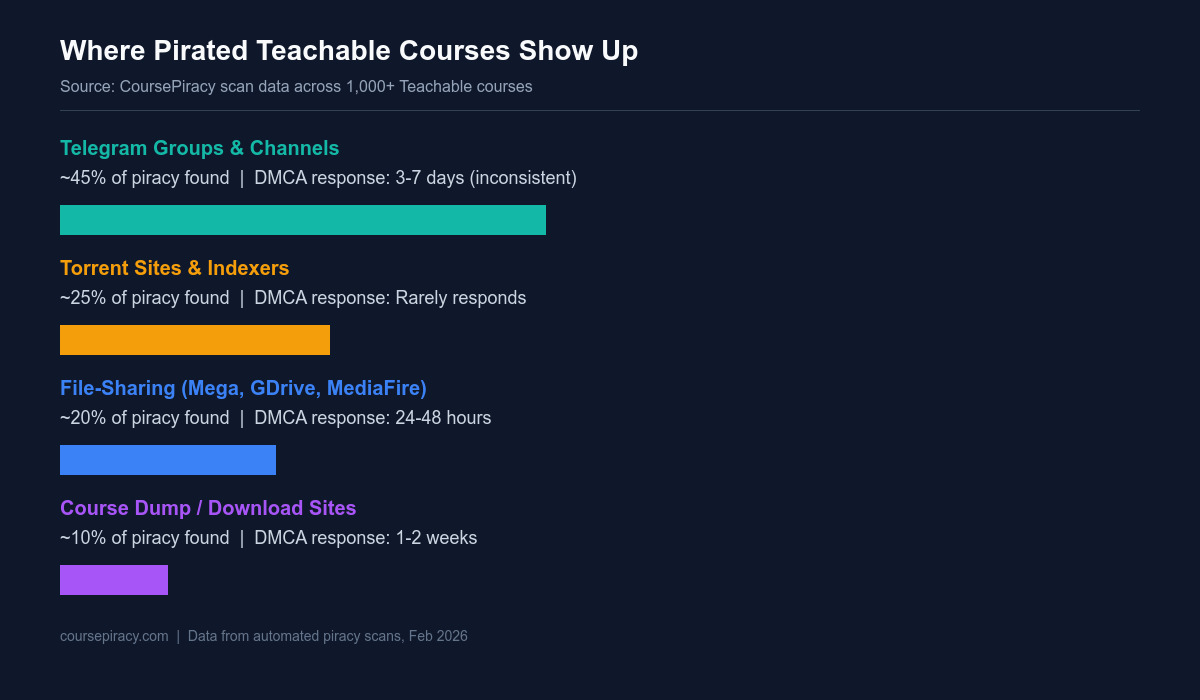
Telegram dominates because it's easy for pirates to create channels, share large files, and reach thousands of members instantly. We've seen Telegram channels with 10,000+ subscribers dedicated entirely to sharing pirated Teachable courses.
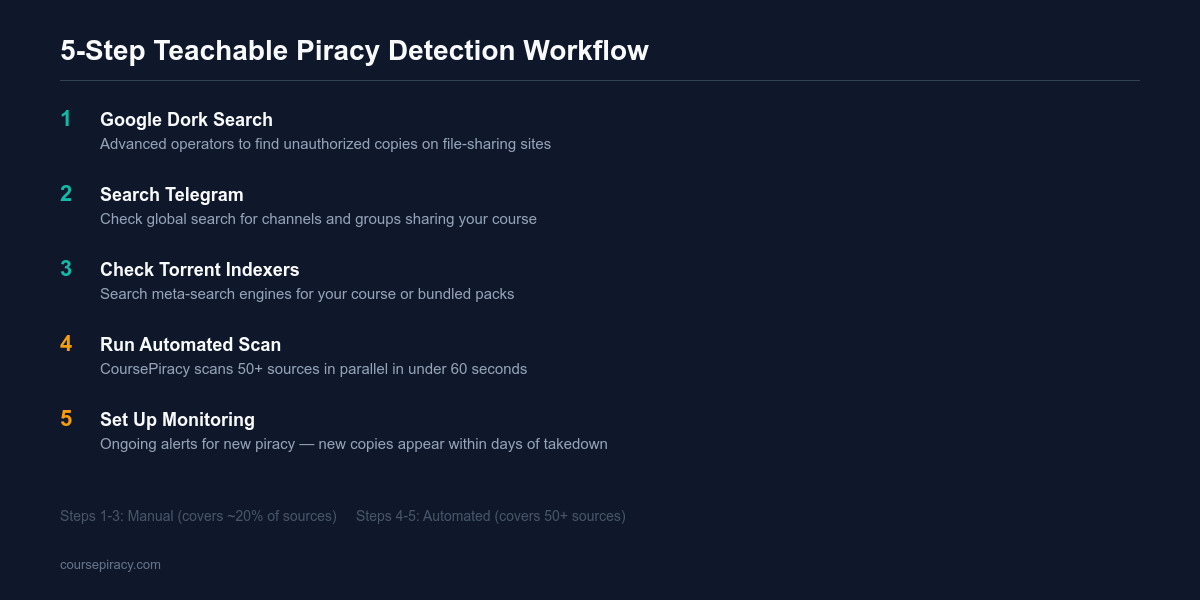
Step 1: Google Dork Search for Your Course
The quickest free method is using Google's advanced search operators (called "dorks") to find unauthorized copies.
Try these searches (replace with your actual course name):
"Your Course Name" filetype:pdf free download
"Your Course Name" torrent
"Your Course Name" telegram free
"Your Course Name" -site:teachable.com -site:yourwebsite.com free
The last search excludes your own site and Teachable, showing only third-party mentions. Look for:
- File-sharing sites (Mega, Google Drive, MediaFire links)
- Forum posts sharing download links
- "Course dump" sites that aggregate pirated courses
- Blog posts offering "free downloads"
Limitations: Google doesn't index Telegram messages, most torrent sites, or password-protected forums. From our testing, Google dork searches alone typically surface less than 20% of actual pirated copies — it's a good starting point, but far from complete.
Step 2: Search Telegram for Your Course
Telegram has become the #1 channel for course piracy in 2025-2026. Pirates create channels with thousands of subscribers and share course files directly or as cloud storage links.
How to search:
- Open Telegram (desktop or mobile)
- Use the global search bar (top of chat list)
- Search for your exact course title
- Look through Channels and Groups results
- Check messages that contain your course name
What you'll find:
| Sign | Meaning |
|---|---|
| Channel with 5,000+ members sharing course files | Active piracy distribution |
| Cloud links (Mega, GDrive) in messages | Direct piracy downloads |
| "DM for course" messages | Pirates selling stolen content |
| Your course cover image shared as a post | Marketing pirated copies |
Limitations: Telegram search is inconsistent. Not all groups are discoverable, and private groups won't show up at all. In our experience, Telegram's built-in search misses a significant portion of piracy channels — our automated pipeline uses more sophisticated query techniques that surface results manual searching can't.
Step 3: Check Torrent Indexers
Torrent sites remain a major source of course piracy, especially for high-value courses that get bundled into multi-GB torrents.
Where to search:
Search your course title on popular torrent meta-search engines. Look for:
- Your exact course name in the torrent title
- "Course collection" torrents that bundle multiple creators' courses
- Your name or brand name in the torrent description
- Recently uploaded torrents (seeders/leechers count shows activity)
Key indicators of active piracy:
| Metric | What It Means |
|---|---|
| 10+ seeders | Active distribution, people are downloading |
| Uploaded recently (< 3 months) | Fresh piracy, likely from current version |
| Multiple trackers | Widely distributed, harder to take down |
| Bundled with other courses | Part of a "mega course pack" |
Limitations: Torrent search requires knowing which indexers to check. There are dozens of active torrent sites, and checking each manually takes hours.
Step 4: Run an Automated Piracy Scan
Manual searching covers maybe 10–20% of piracy sources. We built CoursePiracy specifically because we got tired of the manual process — checking dozens of sites one by one is tedious and incomplete.
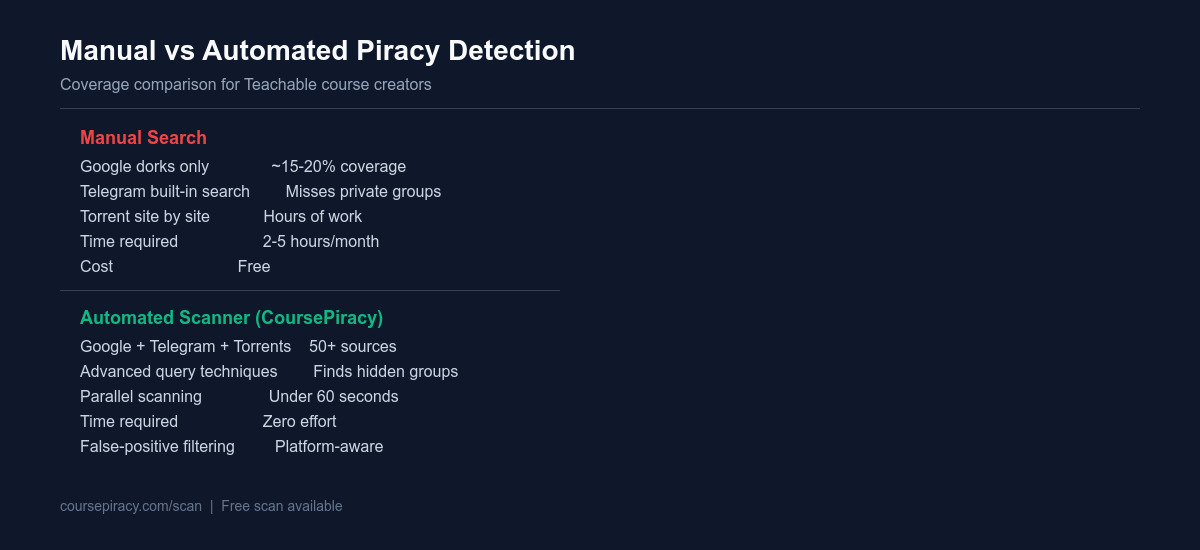
An automated scanner checks 50+ sources simultaneously:
Use CoursePiracy's free scanner:
- Go to coursepiracy.com/scan
- Enter your Teachable course URL and title
- Get results in under 60 seconds
- See piracy links found across Google, Telegram, torrents, and file-sharing
The scanner combines the Google dork techniques from Step 1, Telegram API searches from Step 2, and torrent indexer queries from Step 3 — all automated and running in parallel. It also applies false-positive filtering to exclude legitimate results (like your own Teachable site or authorized affiliate pages).
What you get:
- Verified piracy links, organized by source and confidence level
- Platform-aware results — the scanner recognizes Teachable URL patterns and filters out your own storefront
- Actionable report you can use directly for DMCA takedowns
Step 5: Set Up Ongoing Monitoring
Finding piracy once isn't enough. New copies appear within days of a takedown, and pirates re-upload to different platforms.
Why ongoing monitoring matters:
- A DMCA takedown removes one copy — but the pirate creates another within 48 hours
- New piracy channels on Telegram appear daily
- Torrent re-uploads happen after old torrents get removed
- Course launches and promotions trigger spikes in piracy activity
Monitoring options for Teachable creators:
| Method | Coverage | Cost | Effort |
|---|---|---|---|
| Google Alerts | Google only | Free | Set and forget |
| Monthly manual search | Google + some Telegram | Free | 2-5 hours/month |
| Automated monitoring | Google + Telegram + Torrents + File-sharing | Paid plan | Zero effort |
For courses earning $99+ per sale, automated monitoring pays for itself if it prevents even one unauthorized share per month.
What to Do When You Find Pirated Copies
Once you've found piracy, take action:
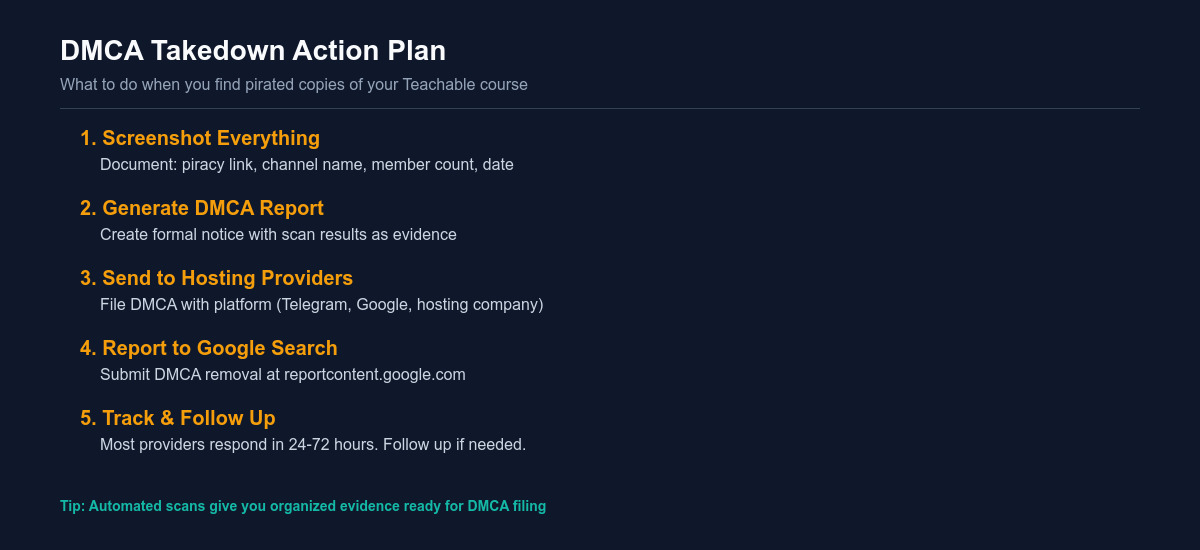
- Screenshot everything — Document the piracy link, page/channel, member count, and date
- Generate a DMCA report — Use your scan results to create a formal DMCA takedown notice
- Send to hosting providers — File DMCA with the site's hosting provider or platform (Telegram, Google, etc.)
- Report to Google — Submit a DMCA removal request to remove piracy from search results
- Track and follow up — Most providers respond within 24-72 hours. Follow up if they don't
For a detailed guide on the DMCA process, see our comparison of automated vs manual DMCA takedowns.
Teachable-Specific Protection Tips
While detection is the focus of this guide, here are quick wins to reduce piracy on Teachable:
- Disable downloads where possible — Force streaming-only for video lessons
- Use drip content — Release modules over time instead of all at once (harder to bulk-download)
- Watermark PDFs — Add buyer's email to PDF materials so you can trace leaks
- Monitor enrollment patterns — Sudden spikes in refund requests may indicate account sharing
- Limit concurrent logins — Use Teachable's built-in session limits to prevent credential sharing
FAQ
Are Teachable courses frequently pirated?
Yes. Teachable is one of the most targeted platforms for course piracy because of its popularity and the high value of courses sold there. Courses priced at $99 or more are especially targeted — pirates know the demand is high. In our scans across Teachable courses, the majority of courses priced above $199 had at least one pirated copy found on Telegram or torrent sites.
Can Teachable prevent piracy of my course?
Teachable provides basic protections like login-required access and no native download option for videos. However, screen recording, browser extensions, and account sharing make these protections easy to bypass. External piracy detection is necessary. We recommend combining Teachable's built-in protections with automated scanning — see the step-by-step approach above.
How do pirates get Teachable course content?
The most common methods are screen recording entire video lessons, using browser extensions to download video files directly, sharing login credentials, and re-uploading content to file-sharing platforms or Telegram groups. From what we've observed, the most common entry point is a single buyer who screen-records the entire course and uploads it to a Telegram channel within days of purchase.
Is it worth filing DMCA takedowns for pirated Teachable courses?
Absolutely. Most legitimate hosting providers remove content within 24-72 hours of receiving a DMCA notice. While some pirate sites ignore DMCA, you can also report them to Google for search result removal, which cuts off discovery. Even partial takedowns have value — removing a course from Google search results dramatically reduces the number of people who find the pirated copy.
How often should I check for piracy of my Teachable course?
At minimum, monthly. Ideally, use automated monitoring that checks continuously. New pirated copies can appear within days of your last check, especially after launches or promotions when more people have access. We've seen cases where a course was re-uploaded to a different Telegram channel within 48 hours of a successful takedown.
Can I find out who pirated my Teachable course?
Sometimes. If the pirate used a unique coupon code, affiliate link, or if you use invisible watermarking, you can trace it back to a specific account. Otherwise, identifying the original leaker is difficult — focus on finding and removing the pirated copies instead. A practical approach: add unique identifiers (like buyer email) to downloadable materials like PDFs, so if they surface on piracy sites, you know which account leaked them.
Related Reading
- Teachable Course Piracy: Complete Protection Guide — Full protection system for Teachable creators
- Teachable DMCA Takedown Guide — Templates for filing DMCA against Teachable piracy
- Course Piracy Statistics 2026 — Data on piracy rates by platform
- DMCA Takedown Guide for Course Creators — Master DMCA guide covering all platforms
- How to Protect Your Online Course from Piracy — Complete protection workflow
Written by
CoursePiracy Team
Digital content protection specialists helping course creators detect and take down pirated copies of their work.
Related Reading
Is Your Thinkific Course Being Pirated? Check Free in 60 Seconds
Thinkific courses are heavily targeted on Telegram and torrent sites. Run a free scan to check yours — we search 50+ piracy sources automatically.
March 8, 2026
Teachable Course Piracy: Complete Protection System [Scan + DMCA + Monitor]
The complete anti-piracy system for Teachable creators: free scanning, DMCA takedown templates, security hardening, and automated monitoring that catches re-uploads.
March 7, 2026
Is Your Kajabi Course Being Pirated? Check Free in 60 Seconds
Kajabi's Cloudflare protection doesn't stop download-and-reshare piracy. Scan free across Telegram, torrents, and 50+ piracy sources instantly.
March 6, 2026
Gumroad Piracy Protection: Find & Remove Pirated Products [Free Scan]
Gumroad has zero built-in piracy protection. Check if your products are being shared on Telegram or torrent sites — free scan + DMCA takedown templates.
March 5, 2026