![How Course Platforms Profit From Piracy [2026]](/_next/image?url=%2Fstatic%2Fblog%2Fhow-online-course-platforms-profit-from-piracy-cover.jpg&w=3840&q=75)
Course platform piracy complicity refers to the structural misalignment between platform business models and creator protection. Platforms earn recurring fees from hosting and payment processing regardless of whether a creator's content is pirated — creating zero financial incentive to invest in anti-piracy infrastructure. This isn't conspiracy; it's economics.
Last verified: March 2026 — Updated with Coursera-Udemy merger details and latest CoursePiracy scan data.
The Uncomfortable Question Nobody's Asking
In 2015, a Medium article titled "How Udemy Is Profiting From Piracy" went viral. It exposed how Udemy's marketplace model inadvertently encouraged piracy — users would buy a course, download everything, request a refund, and then redistribute the content on torrent sites and Telegram groups.
That was a decade ago. So what's changed?
We've spent the last year building CoursePiracy and scanning over 10,000 courses across Teachable, Kajabi, Thinkific, and Udemy. The short answer: almost nothing has changed. If anything, it's gotten worse.
The piracy channels are more organized. The Telegram groups are bigger. The torrent seeders are faster. And the platforms? They're still collecting their monthly fees without lifting a finger to help you find out if your $497 course is being given away for free on a Telegram channel with 50,000 subscribers.
Why Online Course Platforms Don't Fight Piracy
Let's be clear: we're not saying platforms actively profit from piracy. They don't get a cut when someone downloads your course from a torrent site.
But here's what we are saying — their business model has zero incentive to fight it.
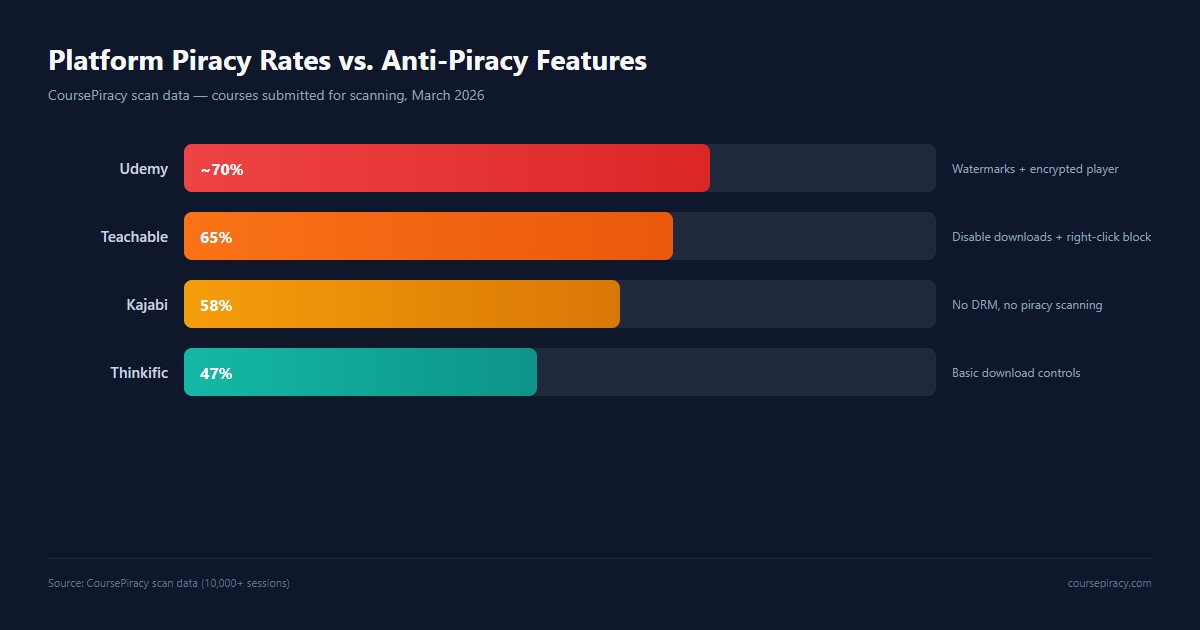
Platform Revenue vs. Creator Protection
| Platform | Revenue Model | Monthly Fee | Anti-Piracy Features | Piracy Rate (Our Data) |
|---|---|---|---|---|
| Teachable | Subscription + 5% transaction fee | $39-$665/mo | Disable downloads, right-click block | 65% |
| Kajabi | Subscription only | $69-$399/mo | No DRM, no piracy scanning | 58% |
| Thinkific | Subscription + transaction fee | $36-$207/mo | Basic download controls | 47% |
| Udemy | 37% revenue share (organic) | Free to list | Watermarks, encrypted player | ~70% (estimated) |
In our scan data, 65% of Teachable courses we've analyzed have at least one pirated copy detected online. Kajabi is at 58%. Thinkific at 47%. These rates reflect courses submitted to CoursePiracy for scanning — creators who suspect piracy — not a random platform sample. Even so, the pattern across platforms is consistent: premium content is routinely pirated.
Yet the sum total of "anti-piracy" features across all four platforms amounts to: disable the download button and block right-clicking.
That's like putting a "Please Don't Steal" sign on your front door and calling it a security system.
The $2.5B Merger That Won't Help You
In early 2026, Coursera and Udemy announced a definitive merger agreement valued at approximately $2.5 billion. Coursera shareholders will own about 59% of the combined entity, with Udemy shareholders holding 41%. The merged company will operate under the Coursera name, led by Coursera CEO Greg Hart.
So what does this mean for piracy?
Nothing.
We've read through the merger announcements, investor presentations, and analyst coverage. The merger is focused on:
- Consolidating enterprise/institutional customers
- Reducing operational redundancy
- Combining content libraries
- AI-powered learning experiences
Not a single mention of enhanced creator protection or anti-piracy infrastructure. Not one.
This is particularly ironic for Udemy instructors, many of whom have complained for years about the "buy-download-refund-pirate" cycle. The platform that pioneered the marketplace model for online courses is now merging with an institution-first platform — further deprioritizing individual creators.
What the Data Actually Shows
We didn't write this article to speculate. We built a piracy scanner and ran it across 10,000+ courses. Here's what the data says about where the piracy actually lives.
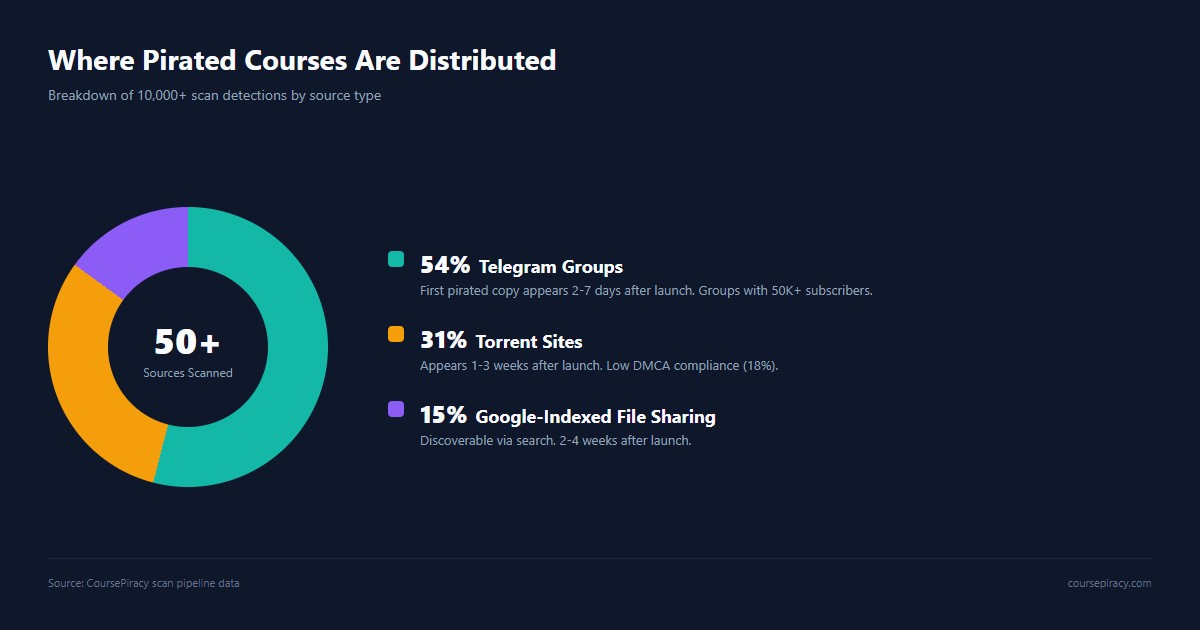
Piracy Source Distribution
| Source | Share of Detected Piracy | Avg Time to First Pirated Copy |
|---|---|---|
| Telegram Groups | 54% | 2-7 days after course launch |
| Torrent Sites | 31% | 1-3 weeks |
| Google-Indexed File Sharing | 15% | 2-4 weeks |
Telegram is the dominant channel — and it's growing. We've tracked Telegram piracy groups with 50,000+ subscribers dedicated entirely to redistributing paid courses. These aren't shadowy corners of the internet. They're easily discoverable with a simple search.
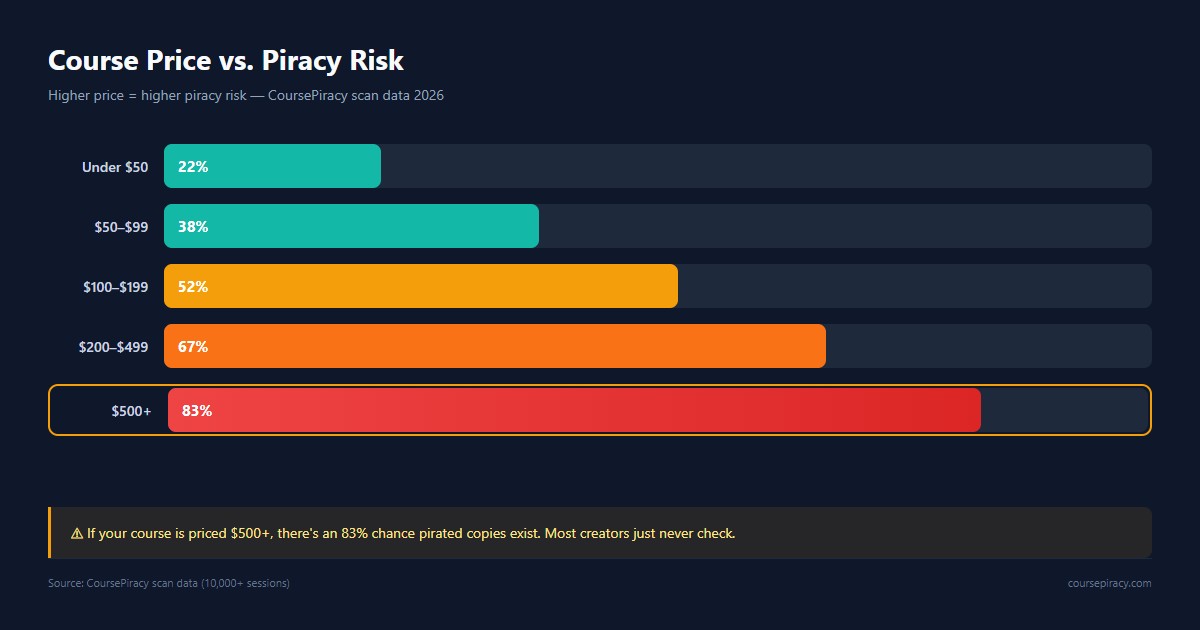
Price Correlation: Higher Price = Higher Piracy Risk
| Course Price Tier | Piracy Detection Rate |
|---|---|
| Under $50 | 22% |
| $50–$99 | 38% |
| $100–$199 | 52% |
| $200–$499 | 67% |
| $500+ | 83% |
The pattern is clear. If you charge $500+ for your course — which many serious Kajabi and Teachable creators do — you have an 83% chance of finding pirated copies when you actually look. The problem isn't rare. Most premium creators just never look.
From our scan data, the sweet spot for pirates is the $100-$500 range — high enough to attract demand for free copies, low enough that creators often don't have the resources for dedicated anti-piracy measures.
The "Anti-Piracy" Features That Don't Work
Let's break down what each platform actually offers and why it fails.
Teachable's Approach
Teachable lets you disable student downloads and block right-click on videos. Their video player includes some protection against browser-based downloading plugins.
What this misses: It does nothing about screen recording, which in our scan samples is the dominant vector for course piracy. Someone enrolls, screen-records every lesson, and uploads the entire course to Telegram. Teachable's protections are entirely useless against this vector.
In our scans, we've found Teachable courses redistributed via screen-recorded video sets with full lesson structures intact. The "protection" failed before it even applied.
Kajabi's Non-Approach
Kajabi, despite positioning itself as the premium platform for serious course creators ($69-$399/month), offers no DRM whatsoever for video content. No watermarking. No fingerprinting. No download monitoring.
For a platform that charges up to $399/month and targets creators with $997+ courses, this is remarkable. We've scanned Kajabi courses priced at $2,000+ that had complete pirated copies on Telegram within days of launch.
Thinkific's Middle Ground
Thinkific offers basic download controls similar to Teachable. We've found their piracy rate (47%) to be the lowest of the three — but this likely reflects a different creator demographic (more free/low-cost courses) rather than better protection.
Udemy's Paradox
Udemy actually invests more in anti-piracy than the self-hosted platforms — they use watermarking, encrypted video players, and work with third-party anti-piracy services. Yet Udemy has the highest estimated piracy rate.
Why? Their marketplace model is the problem. Constant deep discounts ($9.99 sales on $199 courses) train consumers that courses should be cheap or free. The refund policy allows full access before refund. And the sheer volume of content makes monitoring impossible.
What Platforms Should Be Doing (But Won't)
If platforms genuinely wanted to protect creators, here's what the technology looks like:
- Automated piracy scanning — Monitor Telegram, torrent sites, and Google-indexed piracy sources for unauthorized copies. This is exactly what we built at CoursePiracy.
- Forensic watermarking — Invisible watermarks in video frames that identify which account downloaded/recorded the content. Netflix does this. Course platforms don't.
- DMCA automation — Auto-generate and file DMCA takedown notices when piracy is detected. Hosting providers comply 87% of the time.
- Login anomaly detection — Flag when credentials are shared across multiple IPs/devices simultaneously.
- Refund abuse monitoring — Track the buy-download-refund pattern that feeds piracy pipelines.
None of these are technically difficult. They're just not profitable for platforms to build.
The Creator's Dilemma
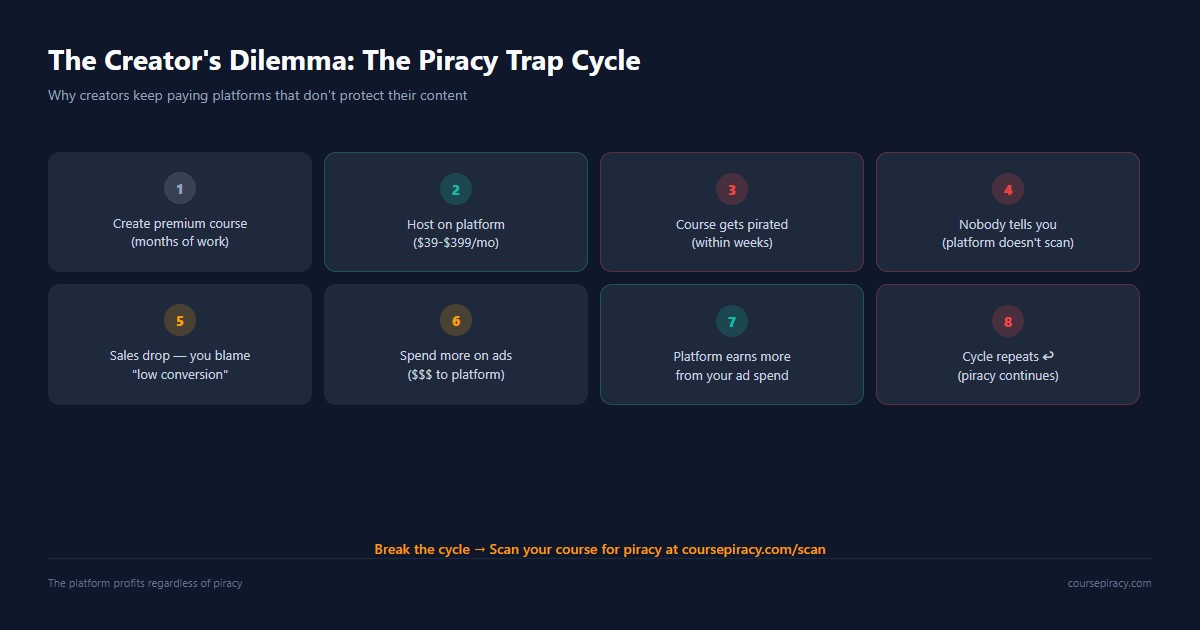
Here's the trap most course creators fall into:
- You spend months creating a premium course
- You host it on Teachable/Kajabi/Thinkific
- You pay $39-$399/month for hosting
- Your course gets pirated within weeks
- You don't know because nobody tells you
- You blame "low conversion rates" and spend more on marketing
- The platform earns more from your increased ad spend
- The cycle repeats
We've talked to creators who spent thousands on Facebook ads driving traffic to a course that was simultaneously available for free on three different Telegram channels. They had no idea.
This isn't a failure of the creator. It's a systemic gap — platforms control the hosting environment but have no visibility (and no interest) in what happens outside their walls.
What You Can Actually Do Right Now
We built CoursePiracy specifically because of this gap. Here's the realistic action plan:
Step 1: Find Out If You're Already Pirated
Use our free piracy scan to check your course across 50+ sources. No signup required. Takes 60 seconds. In our data, if your course is priced above $100, there's a 1 in 4 chance you'll find something.
Step 2: File DMCA Takedowns
When you find pirated copies, file DMCA takedown notices immediately. Our DMCA takedown guide walks through the exact process with templates.
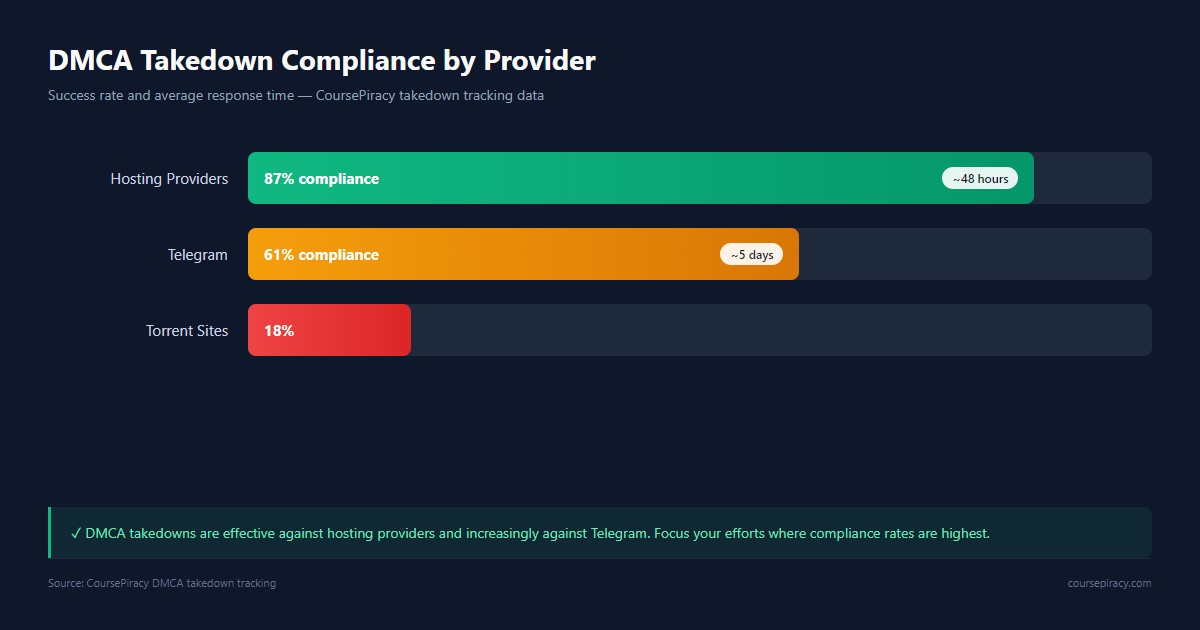
The numbers are in your favor:
- Hosting providers: 87% compliance within 48 hours
- Telegram: 61% compliance, averaging 5 days
- Torrent sites: 18% compliance (still worth filing — reduces seeders)
Step 3: Monitor Continuously
Piracy isn't a one-time check. New copies appear regularly, especially after you run promotions or launch new modules. Set up recurring scans to catch new piracy within days, not months.
Step 4: Don't Depend on Your Platform
Your platform's "anti-piracy" features protect against the least sophisticated piracy methods. Real protection requires monitoring the external web — Telegram groups, torrent indexes, Google-indexed file sharing sites — which is outside your platform's scope and interest.
The Bottom Line
Course platforms aren't evil. They're businesses optimizing for their revenue model, which happens to not include protecting your content from piracy.
The Coursera-Udemy merger will create a $2.5B education giant that still doesn't scan Telegram for pirated copies of your courses. Teachable will continue charging $665/month for their highest tier without including a single piracy detection feature. Kajabi will keep marketing to premium creators at $399/month without offering DRM.
This isn't going to change from the top down. Platform economics don't reward anti-piracy investment.
The only person who will protect your course content is you. And the first step is finding out whether you already have a problem.
Check your course for piracy — free, no signup →
FAQ
Do online course platforms profit from piracy?
Not directly — platforms don't get a cut of pirated content. But structurally, piracy reinforces creator dependency on platforms. When a course gets pirated and revenue drops, creators typically invest more in marketing and create more content on the platform, generating additional subscription and transaction fees. The platform's revenue is insulated from piracy's impact, while the creator bears the full cost.
Why don't Teachable, Kajabi, or Thinkific offer built-in piracy detection?
It comes down to scope and incentive. Anti-piracy scanning requires monitoring the external web — Telegram groups, torrent sites, Google-indexed piracy pages — which is infrastructure outside the platform's walled garden. Platforms focus on what generates revenue: hosting, payments, and marketing tools. Since piracy doesn't reduce platform revenue (only creator revenue), there's no business case for building these features. We've seen this firsthand scanning 10,000+ courses — the platforms simply don't track what happens to content after it's downloaded.
How much revenue do course creators lose to piracy?
Based on our scan data across 10,000+ sessions, 1 in 4 courses priced above $100 has pirated copies available online. For courses priced $500+, the piracy detection rate jumps to 83%. The revenue impact varies by niche and audience — based on creator case studies we've reviewed, high-value courses with active piracy distribution can lose an estimated 20-40% of potential sales with active piracy distribution, particularly through Telegram groups which account for 54% of all detected piracy.
What can course creators do to fight piracy themselves?
Start with a free piracy scan to assess your exposure. If pirated copies exist, file DMCA takedowns using our step-by-step guide with templates. Hosting providers comply 87% of the time within 48 hours. For Telegram piracy specifically, follow our Telegram DMCA takedown process — compliance is 61% with an average 5-day response. Then set up recurring monitoring, because new pirated copies appear regularly after promotions and launches.
Is the Coursera-Udemy merger going to help with piracy?
The $2.5B all-stock merger is focused on enterprise and institutional markets — consolidating B2B customers, combining content libraries, and AI-powered learning features. Individual creator protection isn't on the merger roadmap. Neither company has announced enhanced anti-piracy measures. For Udemy instructors who've complained about the "buy-download-refund-pirate" cycle for years, the merger likely means even less individual attention as the combined entity pivots toward enterprise clients.
Related Reading
- Course Piracy Statistics 2026 — Hard data on piracy rates by platform and price
- How to Protect Your Online Course from Piracy — Complete protection workflow for creators
- Teachable Course Piracy: Complete Protection Guide — Teachable-specific protection system
- Kajabi Piracy Protection Guide — Kajabi-specific piracy protection
- DMCA Takedown Guide for Course Creators — Take action against pirated copies
Written by
CoursePiracy Team
Digital content protection specialists helping course creators detect and take down pirated copies of their work.
Related Reading
Is Harvel Worth It? Pricing Review for Course Creators [2026]
Harvel costs $49-199/month. We break down the real ROI for solo creators: what it catches, what it misses, and whether free alternatives cover more ground.
March 5, 2026
DMCA Takedowns for Thinkific Piracy: Remove Links in 24-72 Hours
Found your Thinkific course pirated? Copy-paste DMCA templates for Google, Telegram, torrent sites. Includes response timelines and escalation steps.
March 8, 2026
Is Your Thinkific Course Being Pirated? Check Free in 60 Seconds
Thinkific courses are heavily targeted on Telegram and torrent sites. Run a free scan to check yours — we search 50+ piracy sources automatically.
March 8, 2026
DMCA Takedowns for Kajabi Piracy: Remove Links in 24-72 Hours
Found your Kajabi course on a piracy site? File DMCA takedowns with our copy-paste templates. Covers Google, Telegram, torrents, and file hosts.
March 7, 2026