![Best Harvel Alternative for Course Creators [2026]](/_next/image?url=%2Fstatic%2Fblog%2Fharvel-alternative-course-piracy-detection-cover.jpg&w=3840&q=75)
A Harvel alternative is a piracy detection tool that offers capabilities beyond Harvel's Google de-indexing approach — such as Telegram scanning, torrent monitoring, platform-specific detection for Teachable, Kajabi, and Thinkific, or different pricing models suited to solo course creators rather than enterprise content teams.
Last verified: March 2026 — Harvel pricing and features verified against harvel.io. CoursePiracy data from our scan pipeline.
What Harvel Does Well
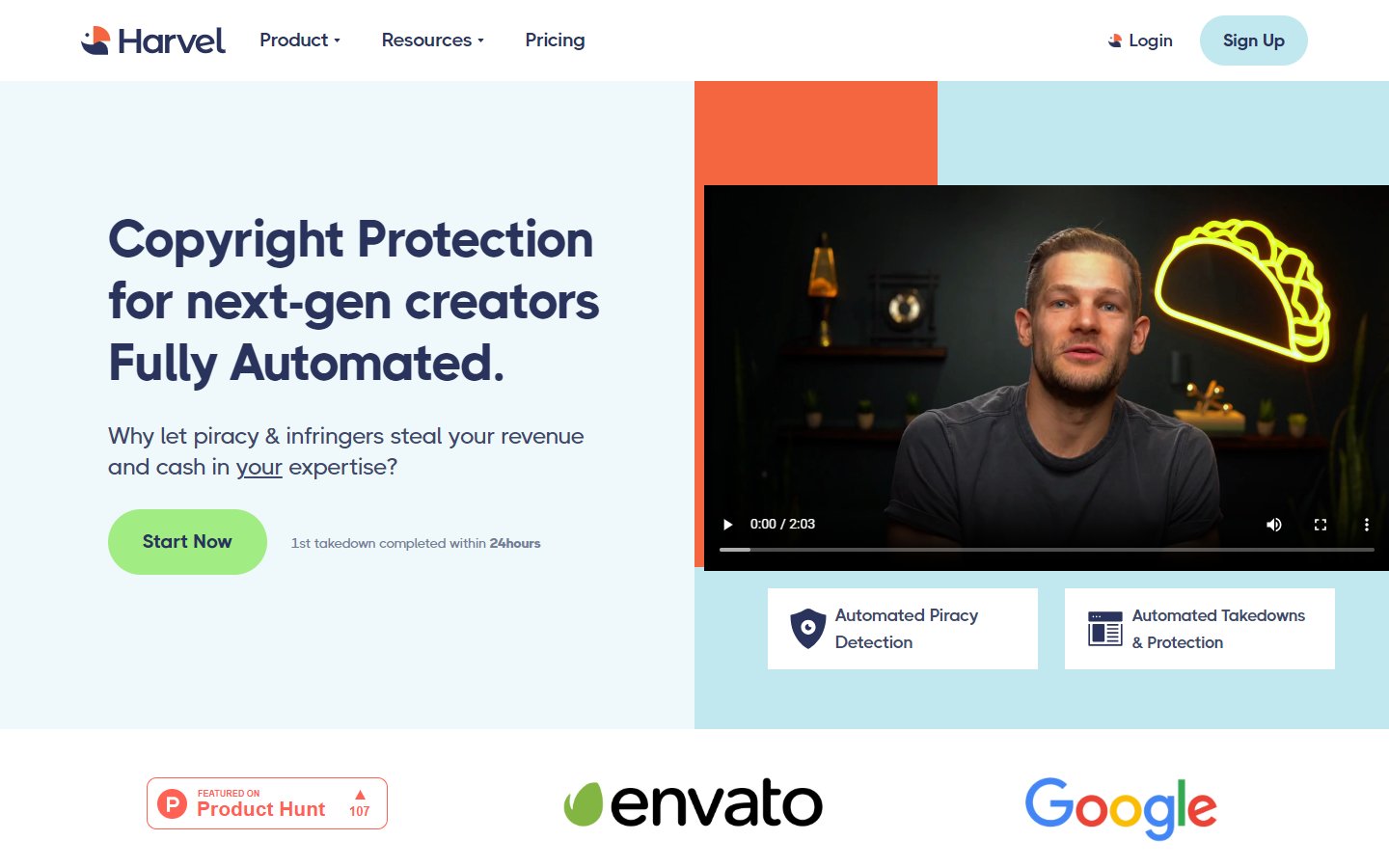
We want to be fair before comparing. Harvel has been in the anti-piracy space since 2019 and was acquired by Ampire in 2022. They've built a reliable system for one specific job: finding pirated content on Google and filing DMCA takedowns to de-index it.
Where Harvel delivers:
- Automated Google monitoring — Harvel scans Google daily for unauthorized copies of your content and files DMCA takedowns automatically
- Fast de-indexing — Most Google de-indexing requests go through within 24-48 hours
- Human verification — Harvel uses a combination of AI detection and human review to reduce false positives
- Weekly reports — You get regular email updates on what was found and removed
- Whitelisting — You can whitelist your own domains and authorized resellers
For creators whose primary piracy concern is Google-discoverable content, Harvel handles that workflow effectively. Their 4.7/5 rating on AppSumo reflects genuine user satisfaction with the Google de-indexing piece.
Where Harvel Falls Short for Course Creators
Here's where we see the gap — and it's significant for course creators specifically. We've analyzed thousands of piracy instances through our scan pipeline, and Google-indexed content is only a fraction of where course piracy lives.
The Platform Gap
Harvel treats all digital content the same — ebooks, music, software, courses. It doesn't understand the difference between a Teachable course landing page and a piracy download page. It doesn't recognize Kajabi URL patterns or Thinkific school structures.
In our experience building CoursePiracy, platform-specific detection matters enormously. When we scan a Teachable course, we know what a legitimate Teachable URL looks like, we understand creator domains, and we filter out false positives that generic tools flag incorrectly.
The Source Coverage Gap
This is the biggest issue. Here's where course piracy actually happens versus what Harvel covers:
| Piracy Source | % of Course Piracy | Harvel Coverage | CoursePiracy Coverage |
|---|---|---|---|
| Telegram groups & channels | ~45% | Not covered | Scanned |
| Torrent sites & indexers | ~25% | Not covered | Scanned |
| Google-indexed sites | ~20% | Covered (de-indexed) | Scanned + flagged |
| File-sharing (Mega, GDrive) | ~10% | Partially covered | Scanned |
These percentages come from our scan pipeline data across hundreds of course scans on Teachable, Kajabi, and Thinkific between late 2025 and early 2026. The reality is that roughly 70% of course piracy happens in places Harvel doesn't look. Telegram alone accounts for nearly half.
In a sample of courses where we detected piracy, over 65% of confirmed piracy instances were found exclusively through Telegram or torrent sources — meaning a Google-only tool like Harvel would have missed them entirely.
The "Remove vs De-index" Problem
Harvel's core function is de-indexing — removing piracy from Google search results. This is valuable but limited:
- The pirated file stays on its hosting server
- Direct links still work
- Telegram channels sharing the link are unaffected
- Torrent clients don't use Google to find content
- Re-uploads appear within days at different URLs
From our data, de-indexed piracy links often get re-uploaded to different URLs within 48-72 hours — we've observed this pattern repeatedly in our monitoring. The game of de-indexing never ends, and it only addresses one discovery path.
Harvel vs CoursePiracy: Feature Comparison
| Feature | Harvel | CoursePiracy |
|---|---|---|
| Google de-indexing | Yes (automated DMCA) | Detection + guidance |
| Telegram scanning | No | Yes |
| Torrent monitoring | No | Yes |
| Platform-specific detection | No (generic) | Yes (Teachable, Kajabi, Thinkific) |
| Free scan tool | No (7-day trial) | Yes — free scan |
| False-positive filtering | AI + human | Multi-layer automated |
| Creator domain recognition | Basic whitelisting | Platform-aware filtering |
| Piracy source reports | Google-focused | All sources with breakdown |
| Course price awareness | No | Yes (prioritizes high-value targets) |
| Founded | 2019 (acquired by Ampire 2022) | 2025 |
| Target audience | All digital content creators | Course creators specifically |
What This Means in Practice
When a Teachable creator with a $497 course runs a Harvel scan, they'll see piracy that's discoverable through Google. That's useful — but it misses the Telegram channel with 8,000 members sharing their course for free, the torrent pack bundling their course with 15 others, and the Mega.nz link being passed around in private Discord servers.
When the same creator uses CoursePiracy's free scan, they get a piracy risk assessment across all these sources. We've had creators discover Telegram channels they didn't know existed — channels with thousands of members who would never have found the pirated course through Google.
Pricing Comparison
| Plan | Harvel | CoursePiracy |
|---|---|---|
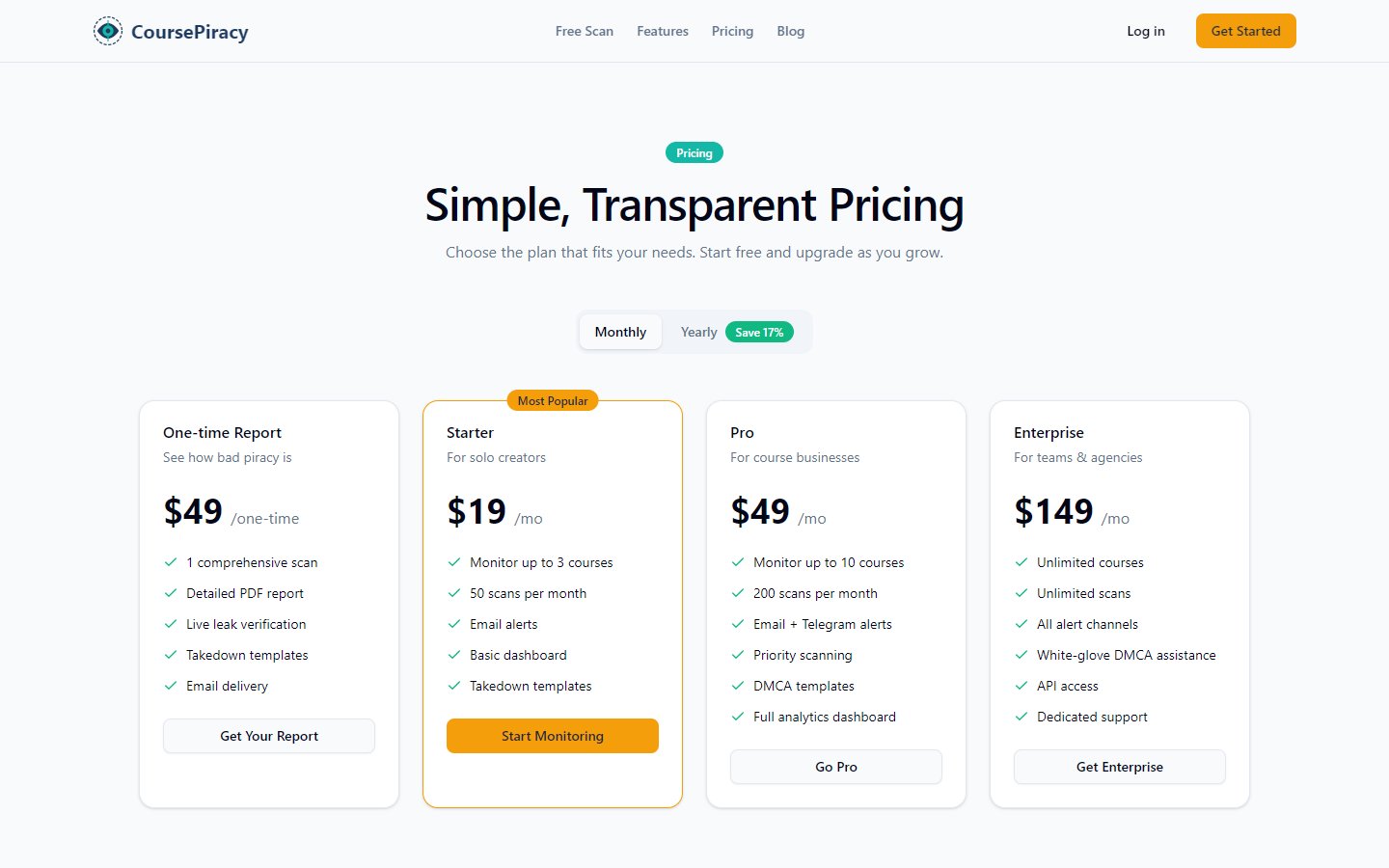
| Free | 7-day trial only | Free piracy scan (try it) |
| One-time report | Not available | $49 one-time (detailed PDF report) |
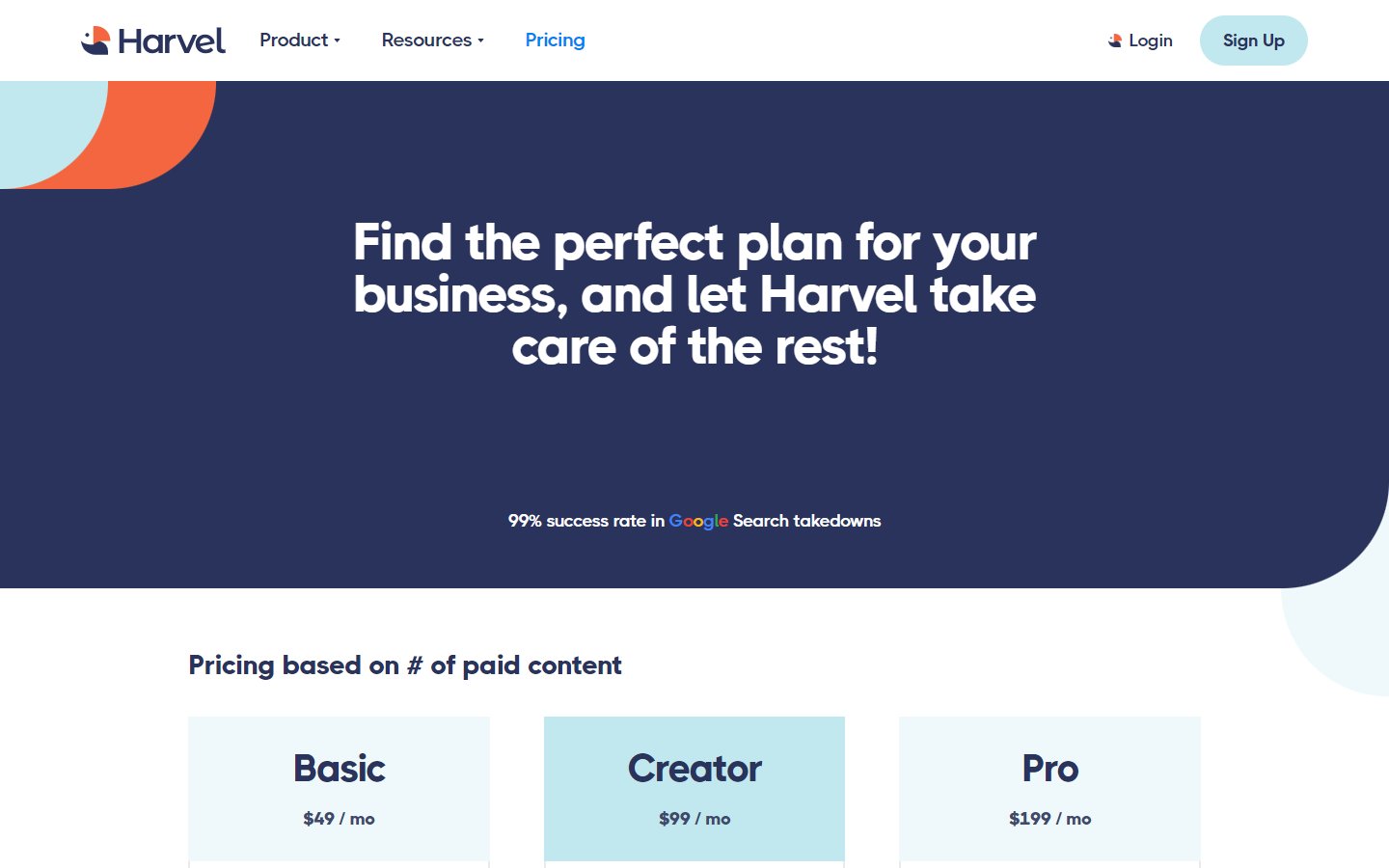
| Entry | $49/month (1 asset) | $19/month — 3 courses, 50 scans (pricing) |
| Mid-tier | $99/month (5 assets) | $49/month — 10 courses, 200 scans |
| Pro | $199/month (30 assets) | $149/month — unlimited courses & scans |
Key pricing differences:
- Harvel charges per "protected asset" — Each course URL counts as one asset. If you have 3 courses, you need the $99/month plan minimum
- CoursePiracy starts at $19/month for up to 3 courses with 50 scans — less than half of Harvel's entry price
- CoursePiracy offers a free scan — You can check if piracy exists before committing to any paid plan. See our full pricing page for details
- Harvel's $49/month minimum is steep for solo creators who earn $2,000-5,000/month from courses
What About Other Alternatives?
Harvel isn't the only option. Here's how the broader landscape looks for course creators:
| Tool | Focus | Price Range | Course-Specific? |
|---|---|---|---|
| Harvel | Google de-indexing | $49-199/mo | No |
| CoursePiracy | Full-source piracy detection | Free scan + $19-149/mo | Yes |
| Red Points | Enterprise brand protection | $500+/mo (enterprise) | No |
| DMCA.com | DIY DMCA + badges | $10-199/mo | No |
| Link-Busters | Bulk DMCA services | Custom pricing | No |
| Manual DMCA | Self-service | Free (your time) | N/A |
For solo course creators, the realistic options are Harvel, CoursePiracy, DMCA.com, or doing it yourself. Red Points and Link-Busters are enterprise tools with enterprise pricing — they make sense for companies with thousands of products, not solo creators with 1-5 courses.
For a detailed guide on filing DMCA takedowns yourself, see our DMCA takedown guide for course creators.
Who Should Use Which Tool?
We're not going to pretend CoursePiracy is the right choice for everyone. Here's an honest breakdown:
Choose Harvel If:
- Your primary concern is Google search visibility of pirated content
- You sell multiple types of digital products (ebooks, templates, software) — not just courses
- You want automated DMCA filing without any manual work
- Your budget is $49-199/month and you're okay with Google-only coverage
- You've already validated that most of your piracy is Google-discoverable
Choose CoursePiracy If:
- You sell courses on Teachable, Kajabi, or Thinkific and want platform-aware detection
- Telegram piracy is a concern (it should be — it's where ~45% of course piracy lives)
- You want to scan first for free before committing to paid monitoring
- You're a solo creator and need piracy detection at a price point that makes sense
- You want full-source coverage including torrents and file-sharing, not just Google
Consider Using Both If:
- You need Harvel's automated DMCA filing AND CoursePiracy's Telegram/torrent detection
- Your courses are high-value ($500+) and piracy represents significant revenue loss
- You want redundant coverage across all channels
Honest limitation: CoursePiracy is newer (2025) than Harvel (2019). Harvel has more years of DMCA filing experience and established relationships with hosting providers. We build on that gap with broader source coverage and course-specific intelligence that Harvel doesn't offer.
FAQ
Is Harvel good for course creators specifically?
Harvel works for all digital content — ebooks, music, software, and courses — but it doesn't differentiate between them. It treats a pirated course the same as a pirated PDF template. For course creators, this means no platform-specific detection (Teachable, Kajabi, Thinkific URL recognition), no understanding of course pricing tiers, and no Telegram or torrent scanning where most course piracy actually happens. It's a general-purpose tool applied to a specific problem.
How much does Harvel cost compared to CoursePiracy?
Harvel starts at $49/month for 1 protected asset, scaling to $99/month for 5 assets and $199/month for 30 assets. CoursePiracy offers a completely free piracy scan — no credit card, no trial timer — plus paid monitoring plans built for solo creators. The key difference: with Harvel you pay before knowing if piracy exists; with CoursePiracy you scan first and only pay if ongoing monitoring makes sense.
Does Harvel detect piracy on Telegram?
No. Harvel focuses on web-based piracy that appears in Google search results. It does not scan Telegram groups, Telegram channels, Discord servers, or private file-sharing communities. From our scan data, Telegram accounts for roughly 45% of all course piracy we detect — making it the single largest piracy channel that Harvel's approach completely misses. For Telegram-specific DMCA guidance, see our Telegram takedown guide.
Can I use both Harvel and CoursePiracy together?
Yes, and some creators do. The combination gives you Harvel's automated Google DMCA filing plus CoursePiracy's Telegram, torrent, and platform-specific detection. However, there's overlap — CoursePiracy also detects Google-indexed piracy, so you'd be paying for redundant coverage on that channel. For most solo creators, one tool is sufficient; using both makes more sense for high-value course catalogs ($10,000+ total revenue at risk).
What happens after Harvel de-indexes a piracy link from Google?
The pirated content stays online — it just becomes invisible in Google search results. Anyone who already has the direct link, follows a Telegram channel sharing it, or uses a torrent client can still access and download the pirated copy. De-indexing reduces discoverability through one search engine, but it doesn't remove the content or prevent sharing through direct links.
Related Reading
- Is Harvel Worth It for Course Creators? — Detailed Harvel pricing and ROI analysis
- Harvel Reviews from Reddit — What real users say about Harvel
- Course Piracy Statistics 2026 — Data showing where piracy actually happens
- How to Protect Your Online Course from Piracy — Complete protection workflow
- DMCA Takedown Guide for Course Creators — DIY takedown templates
Written by
CoursePiracy Team
Digital content protection specialists helping course creators detect and take down pirated copies of their work.
Related Reading
Is Your Thinkific Course Being Pirated? Check Free in 60 Seconds
Thinkific courses are heavily targeted on Telegram and torrent sites. Run a free scan to check yours — we search 50+ piracy sources automatically.
March 8, 2026
Teachable Course Piracy: Complete Protection System [Scan + DMCA + Monitor]
The complete anti-piracy system for Teachable creators: free scanning, DMCA takedown templates, security hardening, and automated monitoring that catches re-uploads.
March 7, 2026
Is Your Kajabi Course Being Pirated? Check Free in 60 Seconds
Kajabi's Cloudflare protection doesn't stop download-and-reshare piracy. Scan free across Telegram, torrents, and 50+ piracy sources instantly.
March 6, 2026
Gumroad Piracy Protection: Find & Remove Pirated Products [Free Scan]
Gumroad has zero built-in piracy protection. Check if your products are being shared on Telegram or torrent sites — free scan + DMCA takedown templates.
March 5, 2026