Fundamentals of U.S. & Canada Cross Border Returns | Canadian Tax — Piracy Status
Canadian Tax Academy returns with their Fundamentals of U.S. & Canada Cross Border Returns course, priced at $349 on Teachable. This specialized program addresses the complex tax obligations faced by individuals and businesses operating across the US-Canadian border. Cross-border taxation requires expertise in both countries' tax systems, making this course valuable for accountants serving clients with international obligations. At $349, it targets practicing professionals who need this specific competency. No piracy scan has been conducted yet, so the course's exposure to unauthorized distribution is currently unknown. As part of Canadian Tax Academy's multi-course catalog, this offering shares both brand reputation risk and piracy vulnerability with their other tax programs.
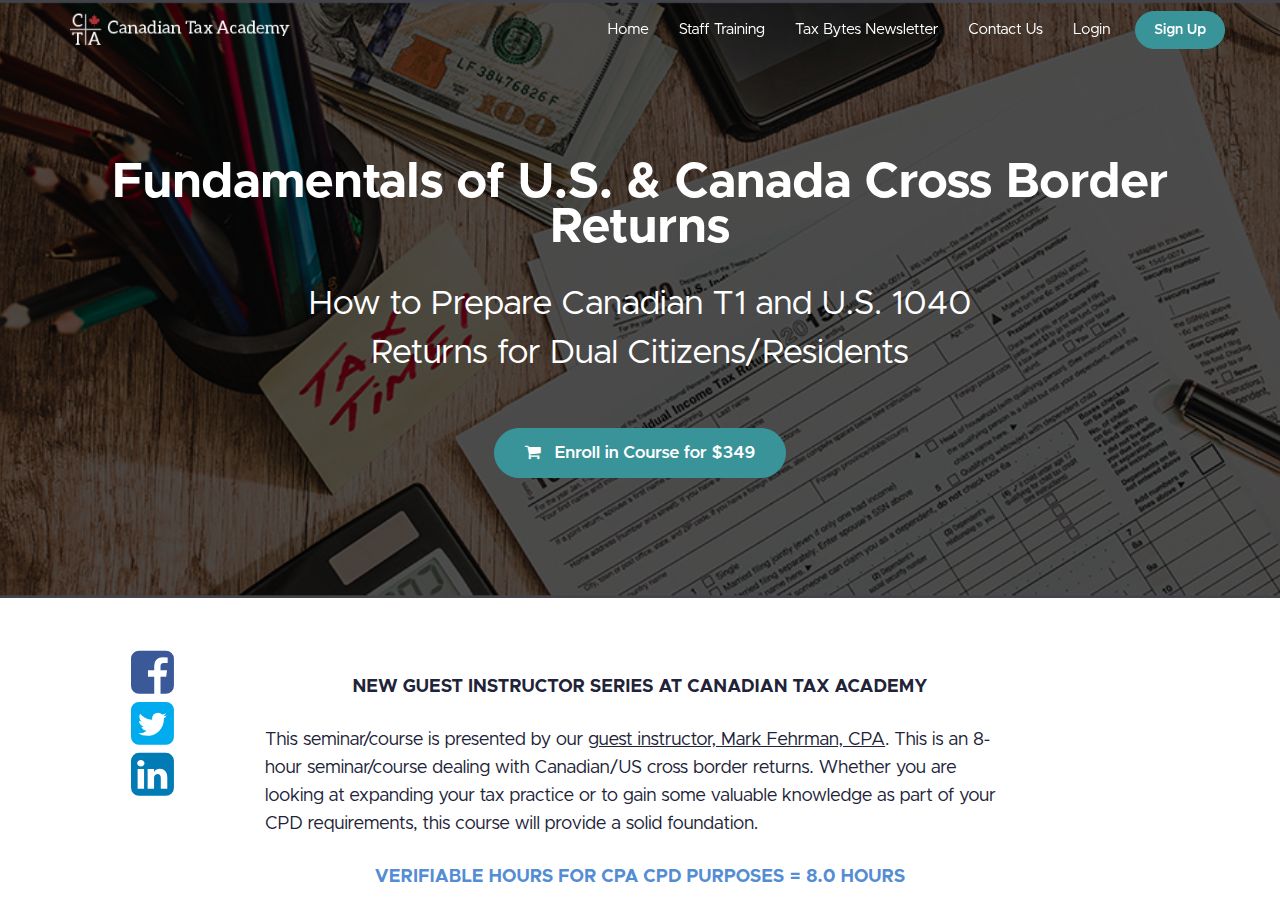
Screenshot of original course page
Pending
Scan in progress
Piracy Threat Analysis
Cross-border tax education combines two jurisdictions' complexity into a single course, creating content with high professional utility and correspondingly high piracy motivation. Canadian Tax Academy's $349 offering serves a specific but sizable market — the US-Canada border represents one of the world's largest bilateral trade relationships, generating substantial demand for cross-border tax expertise. The pending scan status is a notable gap, especially considering that cross-border content appeals to professionals in both countries, effectively doubling the geographic audience compared to purely Canadian tax courses. Teachable's platform hosts the content without advanced DRM, meaning standard piracy extraction methods apply. Cross-border tax content faces an additional piracy vector: professional networks that span both countries share resources more freely across international boundaries where enforcement complexity discourages copyright action. Canadian Tax Academy's multi-course presence on Teachable makes them a catalog-level target — a pirate who obtains one course may be motivated to pursue others. The academy should consider a comprehensive scan across all their courses simultaneously, implement buyer-specific identifiers on downloadable materials, and monitor both US and Canadian accounting communities for unauthorized sharing. Timing scans around filing season for both countries would maximize detection effectiveness.
Priced at $349, this course is in a high-risk bracket. Courses between $200-$500 are among the most frequently pirated — the price is high enough to attract pirates but common enough to have significant demand.
Teachable courses carry a HIGH overall piracy risk. The most common piracy sources for Teachable content include Telegram groups, Torrent sites, Google Drive shares, Course dump sites. On average, pirated copies of Teachable courses appear 2-4 weeks after launch.
Known Teachable Vulnerabilities
- •No native DRM — course videos can be screen-captured or downloaded with browser extensions
- •Direct video URLs sometimes exposed in page source code, allowing direct downloads
- •Wistia-hosted videos can be ripped with third-party tools that bypass the embedded player
- •Account sharing is difficult to detect without session monitoring
Price Context
At $349, this course is in the top 66% of Teachable courses we monitor — placing it in the Mid-Range price tier.
Mid-range courses between $200–499 see consistent piracy activity. This is the most common price point for courses appearing on file-sharing platforms.
Online Education Piracy Intelligence
Cross-border tax education represents a premium subspecialty within the already piracy-prone accounting education niche. The dual-jurisdiction nature expands the potential pirate audience across both countries while creating enforcement complications — DMCA takedowns may prove less effective for content shared through Canadian platforms, and vice versa. Compared to single-country tax courses, cross-border content commands higher prices and attracts more sophisticated professionals, which slightly reduces casual piracy but may attract more organized content theft operations. The niche's seasonal patterns follow both US (April 15) and Canadian (April 30) deadlines, creating an extended window of peak piracy risk each spring. Our detection systems maintain dedicated monitoring coverage for this segment of the online education piracy landscape.
Teachable Security Assessment
Built-in Security
- ✓Login-required access for all course content
- ✓No native video download button
- ✓Content drip scheduling to limit access
- ✓Student session management
- ✓Custom domain with SSL
Limitations
- ✗No DRM or video encryption
- ✗No watermarking built-in (requires third-party tools)
- ✗No download detection or alerting
- ✗Screen recording cannot be prevented
- ✗Limited concurrent session controls
Keep Your Course Protected
Teachable-Specific Protection Steps
- 1.Enable Teachable's built-in content drip to limit how much content is accessible at once
- 2.Use watermarked videos with student name or email overlay on each lesson
- 3.Set up IP access restrictions in your school's security settings
- 4.Limit concurrent login sessions to prevent credential sharing
- 5.Disable PDF downloads for sensitive materials — use in-browser viewing only
Frequently Asked Questions
How do I know if "Fundamentals of U.S. & Canada Cross Border Returns | Canadian Tax" is pirated?▾
What platforms do pirates use for Teachable courses?▾
How much revenue can piracy cost for a $349 course?▾
How common is piracy for Teachable courses?▾
What piracy sources target Teachable courses the most?▾
Can Teachable's built-in protections prevent piracy?▾
Monitor "Fundamentals of U.S. & Canada Cross Border Returns | Canadian Tax"
Your course is safe for now, but piracy can appear at any time. Set up monitoring to get alerted immediately.